Empire Zoysia, Sir Walter or Wintergreen couch: which drought tolerant grass suits a sunny SEQ yard? A grower's comparison, water rules and tips to make any lawn hardier.
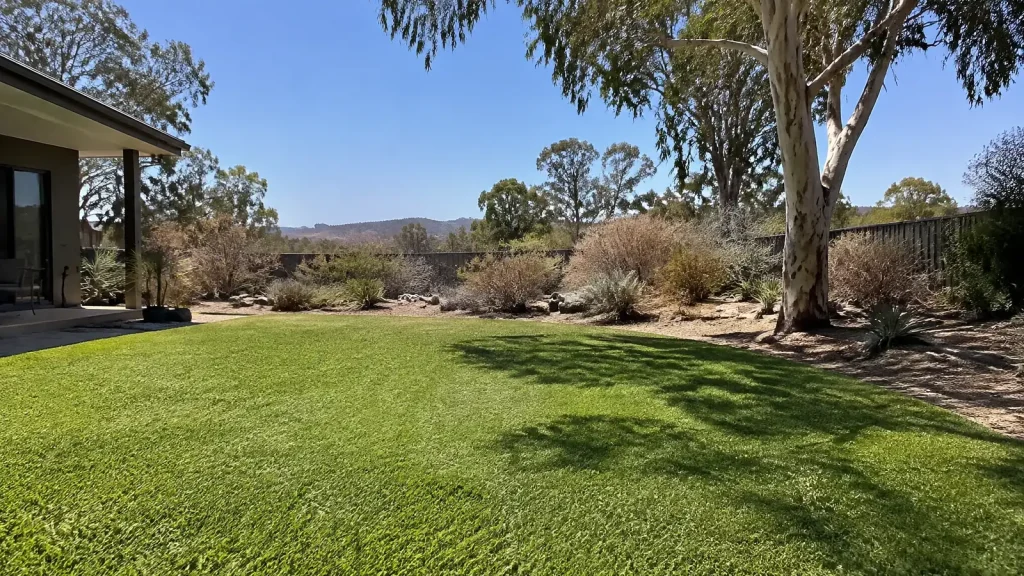
For a sunny Brisbane or Sunshine Coast yard, Empire Zoysia is the most drought tolerant grass we grow and the lowest-maintenance lawn. Sir Walter buffalo is the better pick for part shade and family wear. Wintergreen couch handles full sun and dry spells on a budget but needs more mowing. No turf is drought tolerant until it has rooted in.
This table compares the three drought tolerant grass varieties we grow at Woodford, as at September 2026. The ratings compare them with each other in South East Queensland conditions and assume an established lawn on reasonable soil. For every variety we sell, see our turf varieties.
| Factor | Empire Zoysia | Sir Walter buffalo | Wintergreen couch |
|---|---|---|---|
| Drought tolerance | High. Can live on rainfall once established | Good to high. Deep roots | High, but browns off (goes dormant) sooner |
| Heat tolerance | High | High | High |
| Shade tolerance | Medium (40–50%) | High | Low. Full sun only |
| Wear and recovery | High | Good. Runners self-repair | High. Fast recovery in full sun |
| Mowing in summer | Least often of the three | Regular, about weekly | Regular; fast growing |
| Fertiliser | About once a year | Minimal | About once a season |
| Winter colour | Semi-dormant in winter but holds colour well | Deep green; growth slows in winter | Growth slows in cool weather; greens up in spring |
| Price | $15.50/m² | $15.50/m² | $7.00/m² |
Once you have a variety in mind, measure your yard, then use our turf calculator for an instant price, including delivery and optional installation.
No lawn stays bright green through weeks of heat without water. “Drought tolerant” means a grass can survive a dry spell and come back when the rain returns, and that it needs less supplementary watering to stay presentable. Two things drive that.
Warm-season grasses protect themselves in a dry spell by slowing growth and letting the leaf brown off, while the crown, runners and roots stay alive. Couch is well known for this: it can look straw-coloured in a dry September and green up again soon after decent rain. A lawn that is truly dead has crowns and runners that are dry and brittle all the way through and pull out with no resistance. If you see green at the base of the runners, it is dormant, not dead.
The deeper the roots, the more stored soil moisture the grass can reach after the top few centimetres dry out. Empire Zoysia and Sir Walter both develop deep root systems, which is why they keep their colour longer between rain events (see Empire Zoysia vs Sir Walter buffalo for how they compare on everything else). Roots only grow as deep as the soil and your watering allow, though. Turf on a thin layer of sand over compacted clay will struggle whatever the variety.
South East Queensland’s challenge isn’t year-round drought. It’s the pattern. Late winter and spring are often dry and windy, then the summer storm season can dump a lot of rain in a short time. A lawn here needs to ride out a dry spring, then cope with heavy rain, heat and humidity.
Brisbane, Moreton Bay, Ipswich and the Sunshine Coast all draw on the SEQ Water Grid. According to Seqwater’s Water Wise page, there are no mandatory water restrictions in place as at September 2026, and region-wide restrictions would start if the combined level of the drinking-water dams falls to 50%. Seqwater asks everyone to water gardens before 8am or after 4pm, out of the heat of the day. Check that page before you plan a new lawn, because the rules can change in a long dry spell. A drought-tolerant variety is your insurance if they do.
Many new estates, around North Lakes and Ipswich for example, sit on heavy clay subsoil that was compacted during building. Clay holds water but sheds rain when it is hard and dry, and roots struggle to get into it. Many coastal Sunshine Coast blocks are the opposite: sandy soil that drains fast and holds little moisture. Both need the right underlay before any variety will show its drought tolerance. Our guide to soil under turf covers depths and mixes.
Empire is our most drought-tolerant variety and the best choice if you want a low maintenance lawn. It needs regular water to establish, then its deep roots let it get by on rainfall much of the year. It grows slowly, so it needs less mowing (at 25–50mm) and about one feed a year, far less than couch or kikuyu. It resists pests and disease, has high salt tolerance, which helps near the coast, and medium (40–50%) shade tolerance. The trade-off is slow growth in winter, so it takes longer to knit together than couch.
Best for: sunny front and back yards, owners who want the least upkeep, and coastal blocks with a moisture-holding underlay. See Empire Zoysia turf for the full specifications, or price Empire Zoysia for your yard. Once it is laid, our Empire Zoysia care guide covers mowing, feeding and shade.
Sir Walter is a soft-leaf buffalo. Its licensor, Lawn Solutions Australia, describes it as having excellent drought and shade tolerance, with roots that grow deep into the subsoil. Its dense mat keeps out most weeds and it needs little watering or fertiliser once established. It needs more mowing than Empire, but its strength is flexibility: it copes with sun and part shade, and its fast-growing runners repair wear from kids and dogs.
Best for: family yards with a mix of sun and shade. See Sir Walter buffalo turf, or price Sir Walter for your yard. Weighing it against Empire? Our guide to choosing the right turf walks through sun, wear and upkeep. If shade is your main problem, start with our shade-tolerant turf guide.
Couch is one of the hardiest grasses in a Queensland summer. It spreads by runners above and below the ground, browns off early in a dry spell and bounces back fast with water. It wears and recovers well, which is why couch is common on sports fields. The cost is more work: it grows quickly in summer, so it needs routine mowing and a feed about once a season, and its runners creep into garden beds. It needs full sun and thins out in shade.
Best for: large, open, sunny areas where price matters more than mowing time. See Wintergreen couch turf, or price Wintergreen for your yard.
| Your yard | Our pick | Why |
|---|---|---|
| Sunny, want the least mowing and watering | Empire Zoysia | Deep roots, slow growth, about one feed a year |
| Mix of sun and part shade, kids and dogs | Sir Walter | Drought hardy, shade tolerant, self-repairing runners |
| Large, open, full-sun area on a tight budget | Wintergreen couch | $7.00/m², recovers fast, happy in full sun |
| Coastal, sandy or salty site | Empire Zoysia | High salt tolerance; copes on rainfall once rooted into a moisture-holding underlay |
| Rental or holiday home that gets little attention | Empire Zoysia | Tolerates long periods without attention better than the others |
| Brand-new build | Depends on sun and soil | See our turf selection guide for new builds |
Want it done for you? Our front and backyard turf packages combine preparation, turf and turf installation, or you can request a quote for your block.
The variety matters, but how the lawn is set up and looked after matters just as much. These steps help all three.
Break up compacted ground, fix drainage and lay a quality underlay so roots can go deep. On clay, rip or cultivate the subsoil first. On sand, choose an underlay with some organic matter to hold moisture. Our site and soil preparation team can do this for you.
New turf has almost no roots and dries out fast. In the warmer months, give it light top-ups two to three times a day in week 1, water daily in week 2 and every second day in week 3, then move to two or three deep soaks a week from week 4. Longer gaps between deep waterings push roots down, and that is where drought tolerance comes from. Our 4-week watering schedule for new turf sets it out week by week, and our starter care and maintenance plan covers the first six weeks.
Keep the lawn towards the top of its mowing range in summer and in dry spells. Longer leaf shades the soil and supports deeper roots. Never take off more than a third of the leaf in one mow, and keep your blades sharp so the grass isn’t torn.
An established lawn does better with an occasional deep soak than a light sprinkle every day, which keeps roots shallow. Water before 8am or after 4pm, as Seqwater recommends, to cut evaporation. Watch for the signs of thirst: a dull blue-grey tinge, or footprints that stay pressed into the grass.
Soil that dries out hard, especially sand, can become water-repellent, so rain and irrigation run off instead of soaking in. A wetting agent applied in late winter or early spring, before the dry spring months, helps water get into the root zone. Follow the label rates.
Feeding a stressed, dry lawn pushes leaf growth it can’t support and can burn it. Fertilise when there is moisture in the soil and the lawn is actively growing, and use a slow-release product.
A low maintenance lawn still needs a few well-timed jobs through the year. This is the short version for South East Queensland.
| Season | What to do |
|---|---|
| Spring (Sep–Nov) | Often the driest stretch. Apply a wetting agent early, feed once the lawn is growing, raise the mower and water deeply if it stays dry. A good time to lay new turf. |
| Summer (Dec–Feb) | Storm season. Mow at the higher end of the range, water only in dry breaks, and watch for armyworm and lawn grubs. |
| Autumn (Mar–May) | Recovery time. Feed with a slow-release fertiliser, aerate compacted areas and deal with weeds early. Another good window for laying turf. |
| Winter (Jun–Aug) | Growth slows. Mow less, water only if it is very dry, and hold off on fertiliser until late winter or spring. |
For the full seasonal checklist, see our year-round lawn care plan. If you would rather hand the work over, our lawn care services in Brisbane can help.
Warm-season grasses such as zoysia, couch and soft-leaf buffalo are the most drought hardy in Australian conditions. Of the varieties we grow for SEQ, Empire Zoysia is the most drought tolerant. It can live on rainfall once established.
Both do well. Empire Zoysia is better if you want the least mowing, feeding and watering in a sunny yard. Sir Walter is better if part of the yard is shaded or the lawn takes heavy family wear. Both are $15.50/m².
Spring through to autumn, while the grass is actively growing. Laying in early spring or early autumn gives roots time to establish before the hottest, driest weather. Summer laying works too, as long as you can keep up the watering.
New turf is usually firmly rooted after 2–3 weeks, and well on its way to established after about 6 weeks of good care. Roots keep deepening through its first growing season, so treat it gently in its first summer.
For a sunny or lightly shaded Queensland yard (up to 40–50% shade), Empire Zoysia. It grows slowly, needs about one feed a year, resists pests and disease, and copes on rainfall once established.
Empire Zoysia, as long as the yard gets a reasonable amount of sun. On a new build, soil preparation matters most: compacted builder’s clay needs breaking up and a proper underlay before any turf goes down. See our turf selection guide for new builds.
Grass sold as “no-mow” is usually Zoysia tenuifolia, an ornamental groundcover that grows into soft mounds and doesn’t take much foot traffic. Empire Zoysia is a low-mowing lawn, not a no-mow one. It still needs mowing, just less often.
Usually not. Established warm-season lawns go dormant in a dry spell and green up again after rain or a deep soak. If the runners and crowns are still green at the base, it is alive. New turf is different: if it browns off in its first weeks, water it straight away.
We have grown turf at Woodford since 1994, and every order is cut fresh and delivered across Brisbane and the Sunshine Coast. Choose your variety, measure your yard, then get an instant price with the turf calculator or ask for a quote. For the best start, pair your new lawn with proper site and soil preparation and follow our starter care and maintenance plan for the first six weeks. Not sure which variety suits your block? Call us on 1800 761 334 and we’ll talk it through.
Ready to order turf?
Fresh-cut turf from our Woodford farm, delivered across Brisbane and the Sunshine Coast. Work out your area and price in the turf calculator.
More in Choosing Turf

Copyright ©2026 Hancey's Turf - Designed by Smart Local