Most SEQ yards need 100–150 mm of sandy loam underlay under new turf. Here's how to tell if you need it, how deep to go on clay, fill or sand, and how many cubic metres to order.
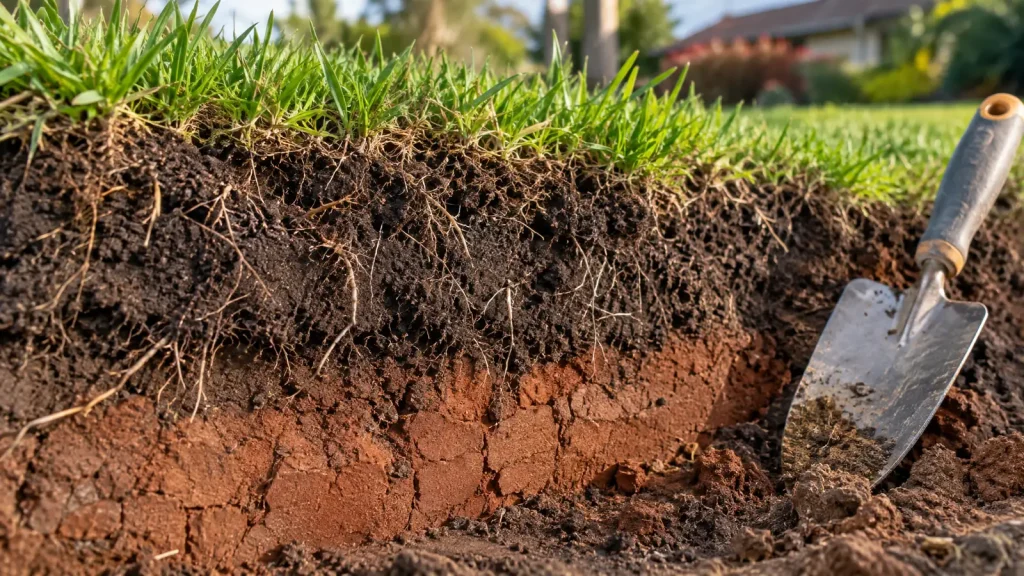
Yes, most South East Queensland yards need 100–150 mm of good soil under turf, usually a sandy loam turf underlay. Treat 75 mm as the bare minimum, and use it only over good, cultivated loam. To work out quantity, allow 1 m³ of underlay for every 10 m² of lawn at 100 mm deep, plus about 10% for settling.
| Recommended depth | 100–150 mm for most sites (75 mm minimum over good loam only) |
| Quantity rule | Area (m²) × depth (m) = m³. So 10 m² at 100 mm = 1 m³ |
| Allow extra | About 10% for settling and spreading |
| Best general mix | A sandy loam turf underlay (often sold as 80/20 or 70/30) |
| Finished level | About one turf-slab thickness below paths and edges, so the turf finishes flush |
| When to lay turf | As soon as the underlay is levelled, firmed and lightly moist |
Turf underlay soil is a soil blend made for new lawns. It’s usually a sandy loam: mostly sand, which keeps it free-draining, with enough loam or composted organic matter to hold water and nutrients while new roots grow. Landscape yards sell it under names like “turf underlay”, “under-turf soil” or “80/20” and “70/30” mixes. The numbers are a ratio, but yards don’t all mean the same thing by them, so ask what each percentage actually is (for example, sand to soil, or sand to compost).
People often confuse two other products with it:
New turf roots into the top 100–150 mm of soil first. If that layer is hard clay, rubble or pure sand, the lawn struggles for years. Here’s how we’d decide:
| Your existing ground | Underlay needed? |
|---|---|
| Deep, crumbly, free-draining loam (an old garden or lawn area) | Often not. Cultivate it, remove weeds and top up low spots |
| Heavy or sodic clay | Yes. 100–150 mm, blended into the ripped clay surface |
| Builder’s fill, rubble or compacted site soil | Yes. Remove the rubble, rip the ground, then add 100–150 mm |
| Coastal sand | Usually. Add a loam-rich layer to hold water and nutrients |
You can skip underlay if you can push a spade in easily, the soil is dark and crumbly, and it drains within a few hours after heavy rain. Dig out the old grass and weeds, loosen the top 100 mm, rake it level and lay. If you’re replacing an old lawn, read whether you can lay turf over existing grass first.
Only if that “dirt” is good loam. Turf laid straight on hard clay or fill usually roots shallowly. It then dries out quickly in summer and goes patchy in the first hot spell.
We recommend 100–150 mm of under-turf soil for most Brisbane and Sunshine Coast sites, the same range given in our turf FAQs. For comparison, Brisbane City Council’s turfing spec for its cricket-pitch surrounds (standard drawing BSD-10212) calls for the existing subgrade to be cultivated to 100 mm, then 100 mm of topsoil (to AS 4419) spread before turfing. Adjust the depth to your soil:
| Site soil | Underlay depth | Notes |
|---|---|---|
| Good loam | 75–100 mm | Cultivate first; underlay mainly evens out levels |
| Clay (incl. sodic) | 100–150 mm | Rip the clay first; gypsum can help dispersive clay |
| Builder’s fill | 100–150 mm | Remove rubble and concrete first |
| Coastal sand | 100 mm | Choose a blend with more loam or organic matter |
50 mm is enough as a top-up over soil that’s already good and has been cultivated. It isn’t enough over clay or fill. A thin layer dries out quickly, and roots hit the hard layer underneath and spread sideways instead of down.
Sandy underlay tipped straight onto smooth, compacted clay can act like a bathtub. Water runs through the sand, sits on the clay and leaves roots waterlogged. Rip or rotary-hoe the clay surface first, then work the first part of the underlay into it so there’s no sharp line between the layers. If the site already holds water, sort out drainage before the soil goes down: see fixing a waterlogged lawn. Drainage correction is also part of our site and soil preparation service.
Multiply your lawn area in m² by the depth in metres (100 mm = 0.1 m). If you haven’t measured yet, our guide on how to measure for turf covers odd shapes. Here’s a worked example: an 8 m × 12.5 m backyard is 100 m². At 100 mm that’s 100 × 0.1 = 10 m³, and with 10% extra, order about 11 m³.
| Lawn area | 75 mm deep | 100 mm deep | 150 mm deep |
|---|---|---|---|
| 20 m² | 1.5 m³ | 2 m³ | 3 m³ |
| 50 m² | 3.75 m³ | 5 m³ | 7.5 m³ |
| 100 m² | 7.5 m³ | 10 m³ | 15 m³ |
| 200 m² | 15 m³ | 20 m³ | 30 m³ |
| 300 m² | 22.5 m³ | 30 m³ | 45 m³ |
Some yards sell by the cubic metre and others by the tonne. A cubic metre of damp sandy loam weighs more than a tonne, so 10 tonnes isn’t 10 m³. Ask the yard for their conversion figure, and check which unit the price and the delivery docket use.
For most SEQ lawns, choose a sandy loam turf underlay with modest organic content. Very high-compost mixes shrink and sink as the organic matter breaks down, which leaves hollows. Pure sand holds too little water. Our grower notes by variety:
“Topsoil” is a broad term, and it can mean anything from a quality loam to a heavy, weedy fill. Turf underlay is a topsoil blended specifically for turf: free-draining, fine enough to level, and low in weed seed. Top dressing is for after the lawn is established, spread thinly to smooth out bumps. Our guide to topdressing and levelling a bumpy lawn explains how.
Underlay prices vary between landscape yards and suburbs, and delivery is often charged separately. Get a delivered price per m³ from two or three local yards. Then compare the whole DIY job against a professional prep: soil, delivery, machine hire and your weekends. For turf itself, our prices are $7.00/m² for Wintergreen couch and $15.50/m² for Sir Walter buffalo and Empire Zoysia. For example, 100 m² of Sir Walter is $1,550 of turf before delivery.
If you’d rather not barrow 11 m³ of soil, our site and soil preparation team can level, decompact and condition the ground, and our turf installation service lays the lawn for you. For a whole front or back yard, see our front and backyard packages.
Not always. Over deep, crumbly loam you can cultivate and lay. Over clay, builder’s fill, compacted ground or coastal sand, which covers most new SEQ yards, 100–150 mm of underlay gives the roots a loose, moisture-holding layer to grow into.
100–150 mm for most sites. Use 75 mm only as a minimum over good, cultivated loam.
Area in m² × depth in metres. So 100 m² at 100 mm needs 10 m³, plus about 10% for settling, which is about 11 m³.
A free-draining sandy loam turf underlay with modest organic content, such as an 80/20 or 70/30 blend. Ask the yard what the ratio refers to.
Yes, if it’s good loam that you’ve cultivated and levelled. On hard clay or fill, turf usually roots shallowly and struggles in summer.
Only as a top-up over good soil. Over clay or builder’s fill, use 100–150 mm.
We don’t sell underlay soil on its own. We grow the turf at our Woodford farm and deliver it across Brisbane and the Sunshine Coast. If you want the ground prepared for you, our site and soil preparation team can level, decompact and condition it before your turf goes down.
Local landscape supply yards sell turf underlay in bulk, and most deliver. Alternatively, have our site and soil preparation team prepare the ground as part of your turf job.
Straight away, once it’s levelled, firmed and lightly moist. Ideally, plan the soil delivery so the turf arrives within a day or two.
Measure once and use the same area for both jobs. Enter it in the turf calculator for your turf estimate, then multiply the same m² by your underlay depth. We harvest fresh at our Woodford farm and deliver across Brisbane and the Sunshine Coast.
Ready to order turf?
Fresh-cut turf from our Woodford farm, delivered across Brisbane and the Sunshine Coast. Work out your area and price in the turf calculator.
More in Laying Turf

Copyright ©2026 Hancey's Turf - Designed by Smart Local