A Woodford turf grower's step-by-step guide to laying turf on Queensland clay, builder's fill and Sunshine Coast sand, from soil tests and gypsum to underlay depth, laying, watering and the first mow.
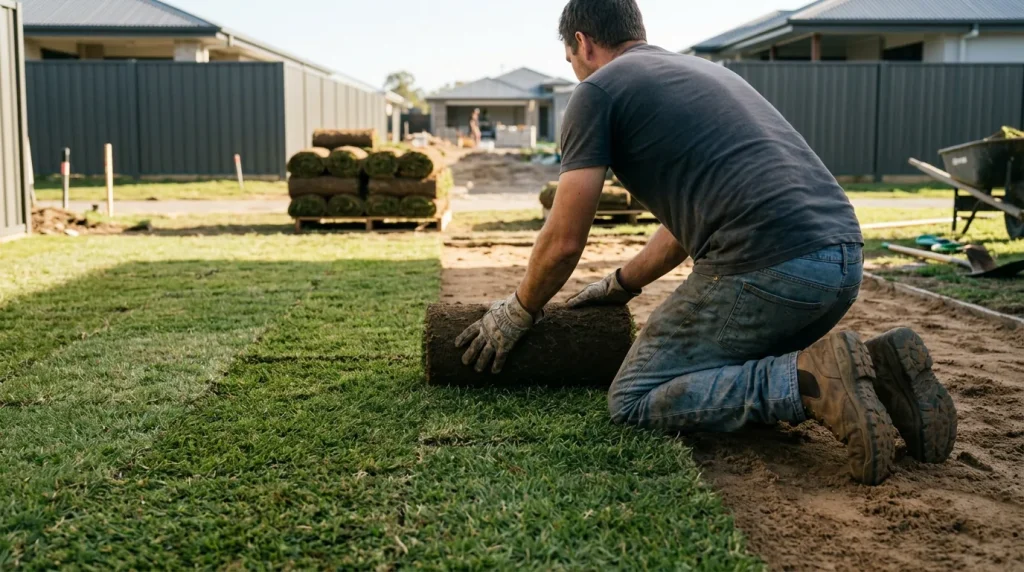
How to lay turf on Queensland clay or builder’s fill: loosen the ground 100–150 mm deep, add gypsum only if the clay is sodic, blend in 100–150 mm of turf underlay, finish 25–30 mm below paths with a fall away from the house, lay fresh turf in a brick pattern the day it arrives, then roll and soak it.
| Item | Rule of thumb |
|---|---|
| Loosen the base | 100–150 mm deep, and only when the soil is moist but not wet |
| Underlay depth | 100–150 mm over clay, builder’s fill or sand; 75–100 mm is enough over good, cultivated loam |
| Finished soil level | 25–30 mm below paths, driveways and edging, so the turf sits flush |
| Order quantity | Measured area plus 5% for cutting in |
| Slab size | Approximately 600 mm × 1200 mm |
| Pallet | On average about 50 m² and roughly 1 tonne; a forklift needs 2.5 m gate access |
| When to lay | The day it arrives, starting along the longest straight edge |
| First water | Water each section as you finish it, then soak the whole lawn |
| First 4 weeks | Week 1: 2–3 light waterings a day · Week 2: once a day · Week 3: every second day · Week 4: 2–3 deep soaks |
| First mow | Usually after 2–3 weeks, once the turf can’t be lifted at the corners |
| Turf prices | Wintergreen couch $7.00/m² · Sir Walter buffalo and Empire Zoysia $15.50/m² |
Laying itself usually takes a day or less for a typical yard. The real work is the ground, so prepare the base first, then book the turf for your laying morning. We cut every order fresh at our Woodford farm and deliver across Brisbane and the Sunshine Coast, or you can pick up from the farm (6am–4pm). Our turf delivery page covers pallets and access.
Measure length × width in metres to get square metres (m²). Break odd shapes into rectangles, triangles and circles, then add 5% for cutting in around beds and curves. Our guide on how to measure for turf walks through each shape. Then put the area into the turf calculator to see the turf cost, delivery and optional installation in one estimate.
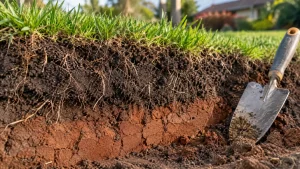
Your soil decides how deep to loosen, whether gypsum is worth buying and how much underlay you need. Many South East Queensland yards, especially on new estates, are clay or builder’s fill, while sandy soils are common closer to the coast. Don’t guess: dig a few spade-deep test holes around the yard first.
For the squeeze test, wet a small handful of soil and work it between your thumb and forefinger. Sand feels gritty and falls apart. Clay feels smooth and sticky and pushes out into a long ribbon. The Queensland Government’s soil texture guide explains how to read the ribbon length.
Next, check whether the clay is sodic. Drop a pea-sized crumb of dry soil into a glass of rainwater and leave it undisturbed for a few hours. If a milky cloud spreads out from the crumb, the clay is dispersive, which usually means it is sodic. Cloudy puddles, a hard surface crust and a soapy feel when wet are other warning signs listed in the Queensland Government sodicity guide. Roughly 45% of Queensland’s soils are naturally sodic, so it is worth testing.
On new estates the top layer is often not natural soil. Look for mixed colours, gravel, concrete, brick or tile fragments, and a hard layer just below the surface where machinery has driven. Rake out anything larger than a golf ball. If you hit a solid layer a spade deep, it needs breaking up (Step 3) before any underlay goes on. Choosing turf for a new house as well? See our guide to turf selection for new builds.
Laying turf on sand is easier in some ways: sand drains well and levels easily. But it dries out fast and holds few nutrients. Skip gypsum and deep ripping, and use an underlay blend with organic matter to hold moisture while roots establish.
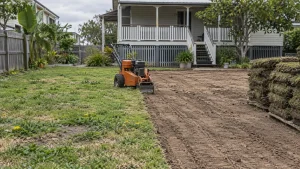
Remove every bit of old grass, weeds, rocks, roots, rubble and building waste. Weeds with runners and bulbs, such as nutgrass, will push up through new turf, so dig them out or treat them and wait before you lay. If there’s an old lawn, don’t lay the new turf straight over it. Our guide on removing an old lawn before re-turfing explains why. Before you hire a rotary hoe, request free plans from Before You Dig Australia so you know where underground services run.
Compacted clay and fill stop roots growing down and water draining away. Loosen the whole area 100–150 mm deep with a rotary hoe, or a garden fork on small patches.
Timing matters more than the machine. If a squeezed handful smears and looks shiny, it’s too wet: working it now creates a dense layer that dries like brick. Wait until it crumbles, which can take days after SEQ summer storms.
Gypsum only helps if the clay is sodic, meaning it passed the cloudy-water test above. On sodic clay, the calcium in gypsum helps clay particles clump together, so water and roots can move through the soil more easily. On clay that isn’t sodic, gypsum does very little, and it never replaces physically loosening a compacted layer. There is no single rate that suits every soil, so follow the rate on the bag and rotary hoe it into the loosened clay rather than leaving it on the surface. Improvement is gradual, not overnight.
Most yards need 100–150 mm of turf underlay. Mix the bottom of the underlay into the loosened clay or fill rather than spreading a thin layer on top. A sharp line between two soils can hold water like a bathtub and stop roots from growing down.
| What’s underneath | Underlay depth | Notes |
|---|---|---|
| Heavy or sodic clay | 100–150 mm | Loosen first; gypsum only if sodic; use the deeper end on heavy clay |
| Compacted builder’s fill | 100–150 mm | Remove rubble, then rip or hoe the compacted layer first |
| Sandy soil | 100 mm | Choose a blend with more loam or organic matter |
| Deep, loose loam (an old garden or lawn area) | Often none; 75–100 mm at most | Cultivate, then top up low spots and level |
As a rough guide, 10 m² at 100 mm deep takes 1 m³ of soil. For volumes, mixes and how to order, read our full guide to soil under turf.
Clay or builder’s fill? We’ll prep the base. If the job is bigger than a weekend, our team can loosen, condition and level it for you. See preparing ground for turf.
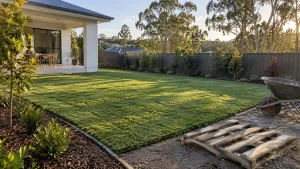
Rake the underlay smooth and finish the soil 25–30 mm below paths, driveways, edging and sprinkler heads so the turf sits flush once laid.
On clay, falls matter as much as the finish. Shape a gentle, even fall away from the house and toward a drain, kerb or garden bed, so heavy summer storms run off instead of pooling. If water already lies in one spot after rain, fix it now. Our guide to fixing a waterlogged lawn covers drains and regrading.
Firm it lightly with a roller, then water to settle it and show up low spots to fill. Just before laying, spread a starter fertiliser at the label rate and lightly dampen the soil.
Stacked turf heats up quickly on a warm day, so lay the whole order the day it arrives, starting early. If rolls must wait, keep the pallet shaded and lightly wet.
A practised layer working straight from the pallet can lay roughly 50 m² an hour. Allow longer if you are wheelbarrowing rolls around the side of the house.
Laying Sir Walter buffalo is the same process as laying zoysia or couch, so the steps above suit any buffalo grass. The difference is where each variety grows best, so match it to your sun before you order. Wintergreen couch ($7.00/m²) needs full sun and recovers quickly from wear. Sir Walter buffalo ($15.50/m²) is a soft-leaf buffalo that copes with shade and sun. Empire Zoysia ($15.50/m²) is fine-leafed and low maintenance, and suits part shade. For side paths and yards shaded by a two-storey house, Sir Walter or Empire is usually the safer choice. Compare them side by side on our turf varieties page.
Order farm-fresh turf delivered the day you lay. All three are cut to order at Woodford and delivered across Brisbane and the Sunshine Coast.
Roll the whole lawn once to press the roots into contact with the soil. Then water deeply until it soaks into the underlay. Lift a corner to check: the soil underneath should be wet, not just the grass. On clay, stop when water starts to pool, then give it a second soak half an hour later.
As a guide in warm weather, give light waterings 2–3 times a day in week 1, water once a day in week 2 and every second day in week 3, then switch to 2–3 deep soaks in week 4. Clay holds water longer than sand, so check before you water: if the soil under a lifted corner is still wet, skip that session. Always follow any water restrictions in your area. For winter timings, sandy soils and how long to run the sprinkler, see our watering new turf schedule.
Mow when the turf can no longer be lifted at the corners, usually after 2–3 weeks. Use a high setting and sharp blades, and never take off more than a third of the leaf. Stay off the lawn as much as you can until then. Around weeks 4–6, give it a slow-release fertiliser and water it in. Our guide on when to mow new turf gives the heights for buffalo, zoysia and couch. If you’d rather hand the first months over to us, see our starter care maintenance plan.
With the base prepared properly, most people can lay their own turf. Here’s how the options compare, using the current figures in our turf calculator.
| Cost item | You lay it | We lay it |
|---|---|---|
| Turf | $7.00/m² Wintergreen · $15.50/m² Sir Walter or Empire | Same turf prices |
| Delivery | Calculator estimate $200, or pick up at Woodford | Calculator estimate $200 |
| Laying | Your time, plus roller hire | Calculator adds $2.50/m², with a $440 minimum |
| Ground preparation | Your time, plus rotary hoe hire, underlay and gypsum if needed | Quoted separately after a site look |
To have it done for you, see turf installation, or our front and backyard packages for a whole new-home yard. For what a full job includes, read our guide to turf installation cost in Brisbane. For the best month to lay, read the best time to lay turf in South East Queensland; September to November is peak laying season in SEQ.
On clay, fill or sand, put down 100–150 mm of turf underlay, blended into the loosened soil below, then spread a starter fertiliser just before laying. On sodic clay, rotary hoe gypsum into the clay before the underlay goes on.
Not on compacted clay or builder’s fill. Loosen it and add 100–150 mm of underlay first. Deep, loose garden loam only needs cultivating, topping up and levelling.
Only on deep, loose loam that you’ve cultivated. On clay, fill or pure sand, turf without underlay roots shallowly and struggles.
Allow 100–150 mm over clay, fill or sand, or 75–100 mm over good loam. As a rough guide, 10 m² at 100 mm deep needs 1 m³ of underlay, and 150 mm needs 1.5 m³.
Yes. Rake it level, firm it lightly with a roller, water it to show up low spots, and finish 25–30 mm below paths with a gentle fall away from the house.
Don’t work wet clay, overlap or stretch slabs, leave rolls on the pallet overnight, walk on the prepared soil, or mow before the turf has rooted.
Avoid laying on waterlogged ground or in the heat of a summer afternoon. Lay early in the day. In South East Queensland you can lay turf year-round, but it roots fastest from spring to autumn.
All three of our varieties grow well on clay that has been prepared properly. Choose by sun and use: Wintergreen couch for full sun, Sir Walter buffalo for shade, and Empire Zoysia for low maintenance.
Keep foot traffic to a minimum for the first 2–3 weeks, until the turf can’t be lifted at the corners. Light use can start after the first mow.
We cut orders to suit, but a pallet holds about 50 m² on average and weighs roughly 1 tonne, depending on recent irrigation. Each slab is approximately 600 mm × 1200 mm.
Multiply length by width in metres for each section, add the sections together, then add 5% for cutting in. Our measuring guide covers odd shapes.
Yes. The hard part is preparing the base on clay or fill; if you’d rather not, we can prepare it and lay it for you.
Once your base is ready, put your measurements into the turf calculator and choose a delivery date that matches your laying day. If you’d like us to look at a clay or builder’s-fill site first, or to prepare it and lay it for you, ask for a free measure and quote.
Ready to order turf?
Fresh-cut turf from our Woodford farm, delivered across Brisbane and the Sunshine Coast. Work out your area and price in the turf calculator.
More in Laying Turf

Copyright ©2026 Hancey's Turf - Designed by Smart Local