Soggy lawn that never dries out? Run a simple 24-hour drainage test, find the cause in your Brisbane or Sunshine Coast soil, and fix the drainage before you returf.
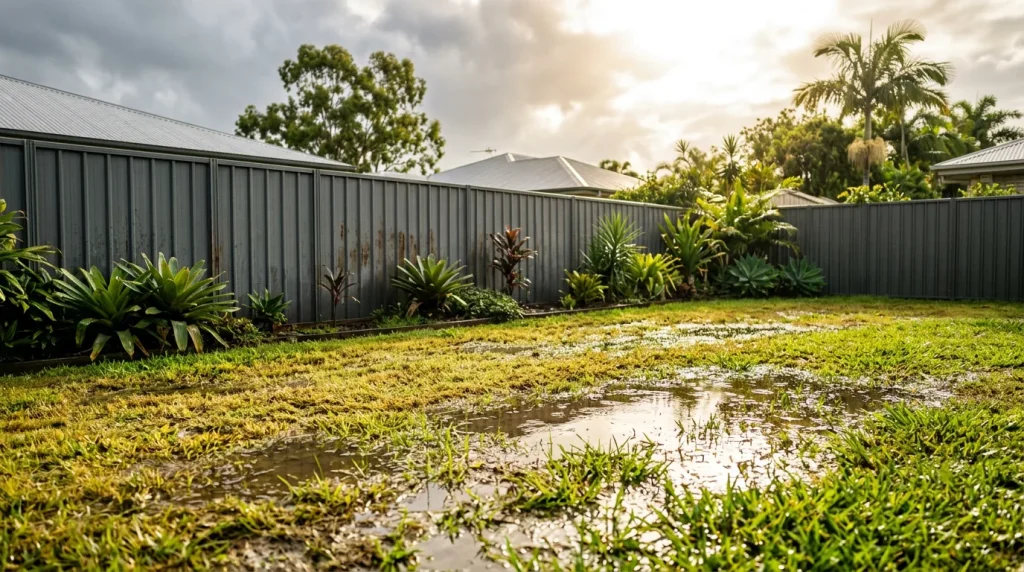
Poor lawn drainage in South East Queensland has five common causes: compacted soil, sodic clay, builder’s fill with no fall, a high water table, or neighbour and roof runoff. Test first: dig a 300 mm hole and fill it with water. If it still holds water after 24 hours, aerating won’t fix it. Fix the drainage, then returf.
| Cause | How to spot it | Usual fix |
|---|---|---|
| Compacted topsoil | A screwdriver is hard to push in; puddles dry within a day | Core aeration plus a sandy top-dress |
| Sodic (dispersive) clay | Surface crusts when dry; a soil crumb in rainwater turns the water cloudy | Gypsum, worked in when you rebuild the profile |
| Builder’s fill or no fall | Water pools in the same low spots after every storm, often near the house | Regrade to a fall, and add ag drains where needed |
| High water table or sand over clay | The test hole fills from below; the ground stays wet for days | Subsurface drainage to a lawful discharge point |
| Neighbour or roof runoff | Water arrives from one side or from a downpipe | Spoon drain or swale, and a licensed plumber for any stormwater work |
Any lawn is soft for a day after a big storm. A drainage problem is the same patch, storm after storm, still wet when the rest of the yard has dried. Look for:
Turn the irrigation off for a dry week. If the patch dries out, cut back your run times. If it stays wet with no rain and no sprinklers, water is getting in from elsewhere (a leaking pipe, a neighbour or groundwater) or has nowhere to go.
This tells you whether the problem is at the surface or deeper. Do it in the worst spot, and in a good spot to compare.
| Result | What it means | Where to start |
|---|---|---|
| Empty within a few hours | The soil drains; the problem is at the surface | Aerate, fix low spots, check the fall |
| Empty by the next day | Slow drainage, usually compaction or heavy clay | Aerate and top-dress; gypsum if the clay is sodic |
| Water still sitting after 24 hours | Impeded drainage under the root zone | A permanent fix: regrade, ag drains or a rebuilt profile |
| Hole fills up from below | A high or perched water table | Subsurface drainage; raise the root zone |
Two more checks: push a long screwdriver into the lawn (if it stops hard at 50 to 100 mm, you have compaction or a clay layer), and next time it pours, watch where the water comes from and where it goes.
Much of Brisbane, Ipswich and Logan sits on heavy clay, and some of it is sodic. The Queensland Government explains that soil sodicity causes surface crusting and sealing and slows water moving through the soil.
On new estates such as North Lakes, Ripley, Yarrabilba and Palmview, yards are often compacted clay fill with a skim of topsoil and little fall. Service trenches settle, and water ends up against the slab or along the fence.
Sandy Sunshine Coast soils usually drain fast. Where sand sits over clay, or the water table is high in low-lying areas, the sand fills like a sponge and stays wet.
If your test hole emptied by the next day, start here.
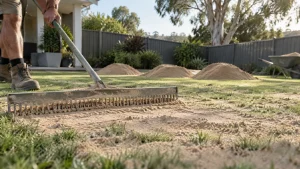
Yes, but only when it gets into the soil. Sand brushed into aeration holes creates drainage channels. A layer spread over clay without aerating does little and can hold water on top of the clay. Avoid brickies’ sand, which contains clay.
If water was still in the hole after 24 hours, change the shape of the ground or give the water somewhere to go.
Shaping, decompacting, subsurface drains within the lawn and returfing are landscape work. Connecting to a stormwater pit, kerb outlet or downpipes is not. In Queensland, drainage work other than unregulated work needs a licensed plumber or drainer, and your water must go to a lawful point of discharge. Your council can tell you where that is. Sunshine Coast Council notes it may get involved if water is concentrated onto a neighbouring property, so don’t push your problem over the fence.
We use the same principles on sports fields. At Genesis College, Bray Park, we built swale drains with subsurface drains along their toe. At Clive Berghofer Stadium, Toowoomba, we reused the red clay site soil, ripped it, added gypsum and lime, and laser-graded it to a 1% fall to swale drains. At Sheldon College, subsurface drains sit on a 1% fall, with gravel bands connecting them to the surface. Our commercial and sports turf construction page has more of that work.
New turf on the same bad base fails the same way, usually in its first wet summer. Work in this order:
This is what our site and soil preparation service covers: levelling, drainage correction such as subsurface drainage and contouring, and soil conditioning before the turf goes down.
No lawn grass likes sitting in water, and no variety rescues a yard that floods. Once drainage is fixed, match the grass to the light and use. Our turf varieties page compares every lawn we grow.
| Variety | Best for | Price |
|---|---|---|
| Wintergreen couch | Open, sunny yards (at least 7 hours of sun a day), where the surface dries quickly after rain. Fast recovery from wear. | $7.00/m² |
| Sir Walter buffalo | Yards with part shade. Soft leaf, and runners that help it self-repair. It copes with shade, not wet soil, so fix the drainage first. | $15.50/m² |
| Empire Zoysia | Low-maintenance lawns and banks. Deep roots and a dense sward. Best laid spring to autumn, as it grows slowly in winter. | $15.50/m² |
All three are cut to order at our Woodford farm and delivered across Brisbane and the Sunshine Coast. Once you have measured your lawn, the turf calculator gives you the square metres and the price.
We price drainage work after seeing the site. The main drivers are:
Doing drainage, soil and turf as one job beats returfing twice. For a whole yard, a front and backyard turf package bundles the site assessment, turf and installation.
SEQ’s heaviest rain usually falls from December to March. August to October is usually the driest time, and storms tend to arrive from late spring, so that is the best window for drainage work: the ground is workable and new turf has a head start before the wet. Wait for summer and you’re working wet clay that smears, with new turf that can wash out. For the turf itself, see the best time to lay turf in South East Queensland.
Artificial grass still needs a free-draining base and a fall, because water drains through the backing into whatever is underneath. We grow and lay natural turf only, but the basics (find the cause, create a fall, discharge lawfully) apply to both.
Do the 24-hour hole test. For mild problems, core aerate, brush in sandy top-dressing, and use gypsum on sodic clay. If water sits over 24 hours, regrade or install ag drains before returfing.
Core aeration and top-dressing for compaction. For surface water, a turfed spoon drain or swale is usually cheaper than buried pipe.
Yes, for compacted topsoil, especially with sand brushed into the holes. It won’t fix a low spot, impermeable clay subsoil or a high water table.
Not when the soil is saturated, in winter when warm-season grass is barely growing, or on new turf before it has rooted in.
Find the cause first: overwatering, compaction, clay, no fall or groundwater. Cut irrigation, aerate compacted areas, and regrade or drain areas that flood. Stormwater connections need a licensed plumber or drainer.
Turn off irrigation, keep traffic off and clear blocked drains or downpipes. Once it firms up, aerate. Soil that stays wet for days needs drainage work.
Puddles lasting a day or more, squelchy ground, thin yellowing grass, shallow roots, moss, algae or sedges, and sour-smelling soil.
Gypsum for sodic clay, and washed sand or sandy loam brushed into aeration holes. When returfing, lay 100 to 150 mm of sandy loam underlay over shaped, decompacted subsoil.
Watch where water comes from in a storm. Redirect runoff with a spoon drain or swale, regrade away from the house, and use ag drains to a lawful discharge point, with a licensed plumber for stormwater connections.
If your lawn floods every wet season, returfing alone won’t fix it. We’ve grown turf at Woodford since 1994, and we can assess your drainage, rebuild the soil profile and lay fresh, farm-grown turf in one job. Read about our site and soil preparation, see our lawn care services for ongoing care, or ask for a free quote.
Ready to order turf?
Fresh-cut turf from our Woodford farm, delivered across Brisbane and the Sunshine Coast. Work out your area and price in the turf calculator.
More in Lawn Problems & Renovation

Copyright ©2026 Hancey's Turf - Designed by Smart Local