How to fix a bumpy lawn in South East Queensland: when thin topdressing is enough, when to lift and relay, and when to level professionally or re-turf.
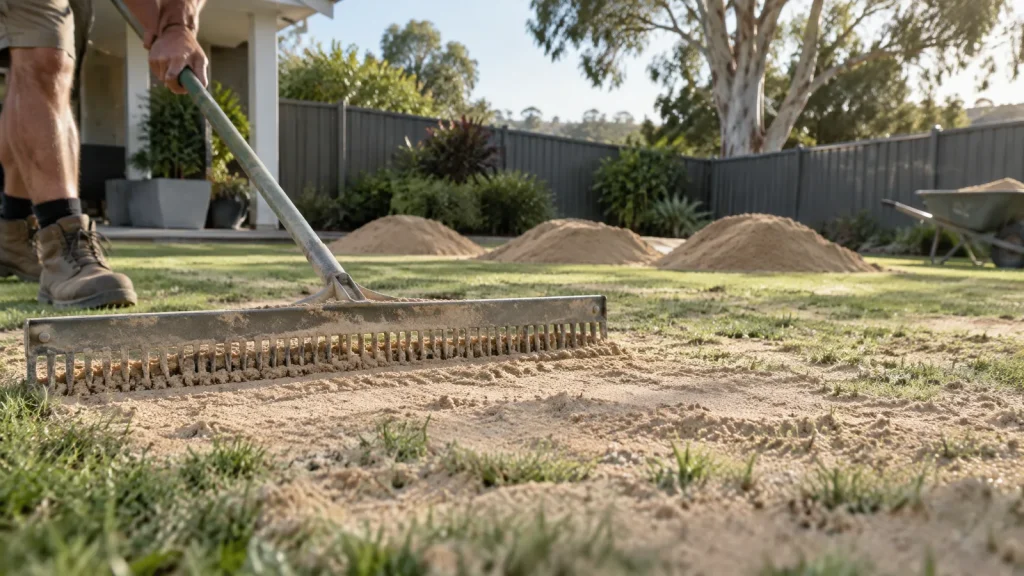
Topdressing lawn bumps works when they are under about 10 mm: spread thin 5–10 mm layers of washed sand or sandy loam while the grass is growing. Hollows of 10–30 mm need two or three passes, weeks apart. At 30–50 mm, lift the turf, fill and relay it. Beyond 50 mm, or where water ponds, level professionally or re-turf.
| Question | Short answer |
|---|---|
| Best time in South East Queensland | September to March, while warm-season grasses are actively growing |
| Best material | Washed topdressing sand, or a sandy loam that suits your existing soil |
| Maximum per pass | 5–10 mm, with the leaf tips still showing |
| Time between passes | 4–6 weeks, once the grass has grown through |
| How much you need | Area (m²) × depth (m) = volume (m³); 10 mm over 100 m² is 1 m³ |
| When not to bother | The lawn is also thin, weedy or dying, or more than 50 mm out of level: re-turf instead |
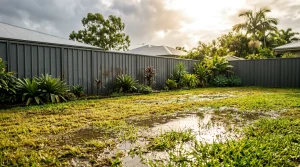
If the low spots stay wet for days after rain, the problem is drainage, not just level, and filling the hollow won’t fix it. Our guide to fixing a waterlogged lawn covers that first, and our site and soil preparation work includes drainage correction.
Lay a straight board or long spirit level (2–3 m is ideal) across the problem area and measure the biggest gap under it with a ruler. Check in a few directions and mark the worst spots. Then use this table to pick your route.
| What you measured | Best fix | DIY or pro? | Where to go next |
|---|---|---|---|
| Gaps under 10 mm | One thin topdressing pass (5–10 mm); grows through in 1–3 weeks | DIY | Topdressing steps below, or ask about our lawn care services |
| Hollows 10–30 mm deep | Two or three passes, 4–6 weeks apart (2–3 months) | DIY | Topdressing steps below, or ask about our lawn care services |
| Dips or humps 30–50 mm | Lift the turf, fill or shave the soil, relay | DIY for small patches; pro for large areas | Lift, fill and relay |
| Over 50 mm, wrong-way falls or ponding | Reshape the ground, fix drainage, often re-turf | Pro | Lawn levelling and site preparation quote |
| Uneven and thin, weedy or dying | Re-turf rather than topdress | DIY or pro installation | Work out your area with the turf calculator, or see turf installation |
Topdress when the grass is growing strongly enough to push back through the new layer. In South East Queensland that is roughly September to March, and spring and early summer are ideal. In winter, warm-season grasses slow down and sand can sit on the leaf for weeks, shading it and inviting weeds. Our year-round lawn care plan shows where topdressing fits with aerating and fertilising.
Your local landscape supplier will stock topdressing sand and lawn mixes. What to avoid: brickies’ sand (it contains clay and can set hard and drain poorly), heavy clay topsoil, and unscreened fill with rocks or weed seed.
Use this formula: area (m²) × depth (m) = volume (m³). A 5 mm layer is 0.005 m and a 10 mm layer is 0.01 m. If you haven’t measured the lawn yet, follow our guide on how to measure your lawn.
| Lawn area | 5 mm layer | 10 mm layer |
|---|---|---|
| 50 m² | 0.25 m³ | 0.5 m³ |
| 100 m² | 0.5 m³ | 1.0 m³ |
| 200 m² | 1.0 m³ | 2.0 m³ |
These are for an even layer over the whole area; filling hollows only takes less. Round up a little, and check whether your supplier sells by the cubic metre or the tonne.
Rather not do it yourself? Top dressing and aeration are among our lawn care services, so ask us for a quote.
For a dip too deep to fill from above, cut an H or a cross through the turf with a sharp spade, slide the spade under and peel the flaps back. Fill underneath with a sandy soil, firm it down, and add a little extra to allow for settling. Lay the turf back, press it in, check the level with your straightedge and water well.
Don’t try to mow a hump away; scalping just weakens the grass. Lift the turf on the high spot the same way, scrape out the excess soil, relay the turf and water it. Where a hump is caused by a tree root, get advice before cutting it.
Yes, as long as the layer is thin and the grass is actively growing. Keep each application to 10 mm or less with some leaf still visible. In warm weather a healthy lawn usually pushes through within one to three weeks. Thick layers, especially of heavy soil, block light and air and can kill the grass, which is why deep hollows need several passes or lifting and relaying.
Topdressing smooths a healthy lawn. It won’t rescue a lawn that is failing. Re-turfing is usually the better investment when:
New turf needs a properly levelled, well-prepared base, which our site and soil preparation and turf installation teams can handle. See turf underlay and soil and laying turf over existing grass. Work out how much you need with the turf calculator, then choose from our three varieties, all cut to order at our Woodford farm: Wintergreen couch turf at $7.00/m², and Sir Walter buffalo turf and Empire Zoysia turf at $15.50/m².
On sports fields, levels are set with laser-guided equipment before any turf goes down. At the Samford Parklands football precinct, the subgrade was laser-trimmed to ±10 mm before the growing medium and turf went down, and the fields were then maintained with regular sand topdressing. At the Bob Brock soccer field, a 100 mm sand layer was laser graded and rolled before Wintergreen couch was laid. At the Metricon Stadium training field at Carrara, a light topdressing after the drainage trenches were backfilled brought the surface back to level. The principle is the same at home: get the base right, then fine-tune with thin topdressing. See our commercial and sports turf work for more.
In South East Queensland, topdress between September and March, while warm-season grasses are actively growing. Spring and early summer are ideal. Avoid winter, when growth slows and the grass can’t push through the new layer.
Yes, if the lawn is healthy and the bumps are shallow. Thin topdressing smooths the surface, makes mowing easier and can help manage thatch. If the lawn is thin, weedy or badly out of level, re-turfing is usually better value.
Multiply the area in square metres by the depth in metres. A 5 mm layer needs 0.005 m³ per m² (0.5 m³ per 100 m²), and a 10 mm layer needs 0.01 m³ per m² (1 m³ per 100 m²).
Only in thin layers, around 10 mm or less, with the leaf tips still showing. Thick layers of topsoil smother the grass. For deeper hollows, lift the turf, fill underneath and relay it.
For shallow bumps, spread washed sand in thin layers with a levelling rake and water it in. For deeper dips, lift the turf, fill underneath and relay it. Large or sloping areas are easier to level professionally.
It’s best avoided. Brickies’ sand contains clay, so it can set hard and drain poorly on a lawn. Use a washed topdressing sand or a sandy loam lawn mix instead.
Too bumpy to fix yourself? Send us your measurements and a few photos through our free quote form. We can advise whether it needs topdressing, levelling and site preparation, or new turf, across Brisbane and the Sunshine Coast.
Ready to order turf?
Fresh-cut turf from our Woodford farm, delivered across Brisbane and the Sunshine Coast. Work out your area and price in the turf calculator.
More in Lawn Problems & Renovation

Copyright ©2026 Hancey's Turf - Designed by Smart Local