How to tell lawn armyworm from curl grubs and African black beetle in South East Queensland, how to treat them, and how to decide whether your lawn will recover or needs re-turfing.
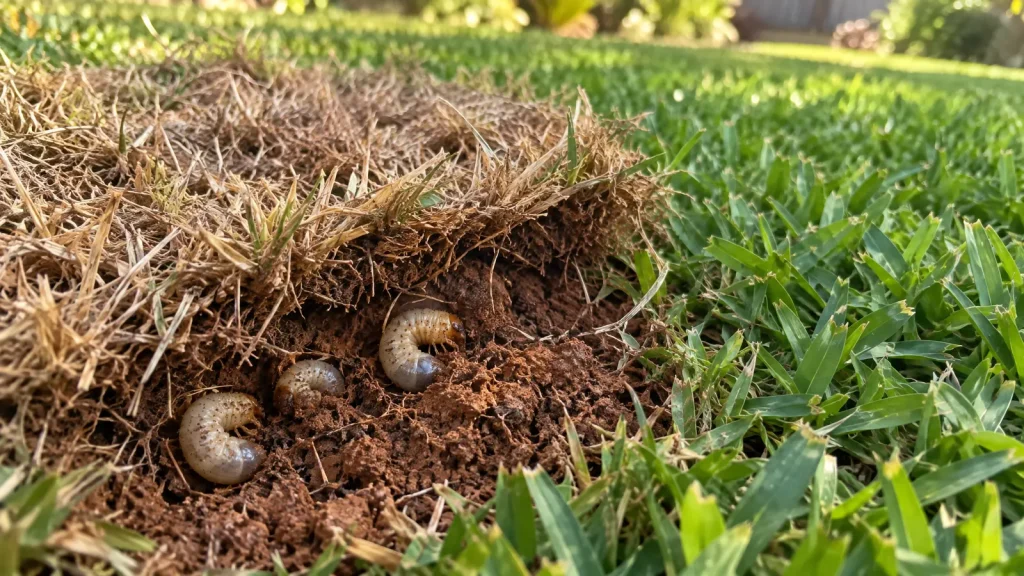
Lawn grubs and lawn armyworm (Spodoptera mauritia) cause most brown patches that spread in days across South East Queensland lawns from late spring to autumn. Armyworm chews the leaf, and a soapy water test brings it up. Curl grubs eat the roots, so the turf lifts like carpet. Treat late in the afternoon with a labelled product. If the runners are still green, the lawn usually regrows.
| Lawn armyworm | Curl grubs (scarab larvae) | African black beetle | |
|---|---|---|---|
| What it looks like | Caterpillar up to about 40mm, greyish brown with pale stripes along the body | Creamy-white, C-shaped grub with a brown head. Size varies with the beetle species | Adult: shiny black beetle, 10–15mm. Larva: a small white curl grub |
| What it eats | Leaf and stem, above the ground | Roots, below the ground | Larvae eat the roots; adults chew the stems at the soil surface |
| When damage shows in SEQ | Late spring to autumn, often after summer storms | Summer to autumn | Spring to autumn |
| Tell-tale sign | Grass chewed short over a moving front | Turf feels spongy and lifts like carpet; birds, bandicoots or ibis digging | Dead patches that pull up easily; beetles in the thatch |
| Best test | Soapy water test, or wet hessian overnight | Cut back a square of turf and look for grubs | Soapy water test or wet hessian for adults; dig for larvae |
| Usual recovery | Often good, because the runners usually survive | Slower, because the roots are gone | Slower if the larvae have damaged the roots |
Lots of things turn a Queensland lawn brown, including dry spells, fungal disease, dog urine, scalping with the mower and poor drainage. Our guide to grubs, diseases and weeds in Queensland lawns covers the other causes. Check these signs before you buy anything.
This is the quickest way to confirm armyworm. Do it late in the afternoon, when the caterpillars are most active.
If you’d rather not use soap, lay a wet hessian bag or old towel on the lawn overnight and lift it early in the morning. Caterpillars and beetles often shelter underneath.
Most “armyworm” news is about fall armyworm (Spodoptera frugiperda), an exotic pest that reached the Australian mainland in 2020 and mainly attacks crops such as maize and sorghum, according to Business Queensland. The caterpillar in Brisbane and Sunshine Coast lawns is almost always lawn armyworm (Spodoptera mauritia), a native species.
Lawn grubs feed in the root zone, so the damage stays hidden until the grass dies. Suspect them if brown patches don’t green up after watering, the turf feels spongy, or birds and bandicoots keep digging the same area.
The soap test often won’t bring grubs up. Instead, cut three sides of a square about 30cm × 30cm at the edge of a dead patch with a spade. Fold the turf back and look in the top 5–10cm of soil for creamy-white grubs curled into a C-shape. Check a few squares across the lawn. If you keep finding several in each square and the turf lifts easily, grubs are the likely cause. African black beetle adults show up in a soap test or under wet hessian, and their larvae look like small curl grubs.
In South East Queensland, curl grub damage usually shows through summer and into autumn, after the beetles have laid their eggs in late spring and early summer. Grub products generally work best on young larvae near the surface, so treat as soon as you confirm grubs in early to mid summer rather than waiting until autumn. Check the label for the timing it recommends; some products are designed to go on before the eggs hatch.
Business Queensland’s native armyworm page notes that armyworm moths generally fly in September and October, and that lawn armyworm can complete two to three generations over the warm months. In South East Queensland, that means:
For what to do in each season, see our year-round lawn care plan.
We don’t recommend brands. Read the active ingredient and check that the label lists your pest and use on home lawns. The label is the law: use the rate, method and re-application interval it gives, and wear what it tells you to wear. Actives you’ll commonly see on Australian lawn insecticide labels include:
Keep pets and children off treated areas for as long as the label says, and at least until the product has dried or been watered in. Never apply before heavy rain or spray into gutters and drains, which run to local creeks and the bay.
Often, yes. The question that matters is whether the runners and crowns are still alive. Armyworm eats leaf, so a lawn can look dead while the runners (stolons) underneath are fine. Grubs eat roots, so the damage is deeper and recovery is slower.
Wintergreen couch, Sir Walter buffalo and Empire Zoysia are all warm-season runner grasses, so they can regrow from live runners in the warm months. No variety is immune to armyworm or grubs, although Empire Zoysia is less susceptible to lawn grubs. Recovery is much faster from October to March than in winter, and a lawn damaged in late autumn may sit brown until spring.
For routine care once it’s back, see our lawn care overview and seasonal turf care guide.
Once the pests are under control, use this as a rough guide. As a rule of thumb, if more than about a third of the runners in an area are dead, re-turfing that area is usually quicker and more reliable than waiting.
| What you find | Likely outcome | What to do |
|---|---|---|
| Leaf eaten, runners green and firm, warm weather | Recovers | Follow the 7-step plan |
| Small dead patches (a few m²), the rest recovering | Patch | Cut out and patch re-turf the dead areas |
| More than about a third of the runners dead across a large area | Slow, patchy recovery, and weeds move in | Re-turf the affected areas |
| Grubs took the roots, and the turf lifts like carpet over large areas | Poor recovery | Treat, then re-turf |
| Infestations every year and a thin, stressed lawn | Underlying problem (soil, drainage, shade or the wrong variety) | Fix the cause, then consider a better-suited variety |
| New lawn (first season) badly damaged | Shallow roots, so higher risk | Check the runners. Patch or re-lay if they’re dead |
Lawn looks dead? Get it checked. If you can’t tell whether it will come back, our lawn care team can help you decide whether to nurse it back or replace it. Replacing patches? Work out your m² with the turf calculator, then order turf delivery to Brisbane or the Sunshine Coast.
Match the variety to what’s already there. Wintergreen couch is $7.00/m², and Sir Walter buffalo and Empire Zoysia are $15.50/m².
Armyworm chews the leaf and the damage moves; a soapy water test brings the caterpillars up. Grubs eat the roots, so the turf lifts like carpet; dig a 30cm square and look for white, C-shaped grubs.
Usually, if the runners survived. Scratch a runner: green and firm inside means it will regrow with fertiliser, water and warmth. If most are brown and brittle, patch or re-turf.
It can, but more slowly, because the roots are gone. Treat, then feed and water. Large areas that lift off with no roots usually need re-turfing.
Armyworm moths generally fly in September and October. Caterpillar and grub damage usually shows from late spring through to autumn, often after warm, humid weather and summer storms.
A lawn insecticide labelled for armyworm, applied late in the afternoon. Actives you’ll see on labels include bifenthrin and chlorantraniliprole, and Bt and spinosad are biological options. Always follow the label.
Each generation turns into moths, but only after doing the damage, and another can follow. If the brown area grows daily, act.
The bigger concern is the treatment. Keep pets off treated areas for as long as the label says, and store products out of their reach.
Moths. The caterpillars pupate in the soil, and the moths lay the eggs for the next generation, which is why spring moth flights are an early warning.
Once a re-test shows the pests are gone and the label’s re-entry or planting interval has passed, prepare the soil and lay.
No variety is armyworm-proof, including Sir Walter buffalo. Recovery depends on whether the runners survived, so do the scratch test first.
Only where the runners and roots are dead. Patch small areas; if more than about a third of an area is dead, re-turfing it is usually faster than waiting.
If a patch or full re-turf is the answer, request a quote for turf delivered across Brisbane and the Sunshine Coast, or ask about turf installation if you’d rather have it laid for you.
Ready to order turf?
Fresh-cut turf from our Woodford farm, delivered across Brisbane and the Sunshine Coast. Work out your area and price in the turf calculator.
More in Lawn Problems & Renovation

Copyright ©2026 Hancey's Turf - Designed by Smart Local