A week-by-week watering schedule for new turf in Brisbane and the Sunshine Coast, with summer and winter amounts, sprinkler run times and the tug test to check rooting.
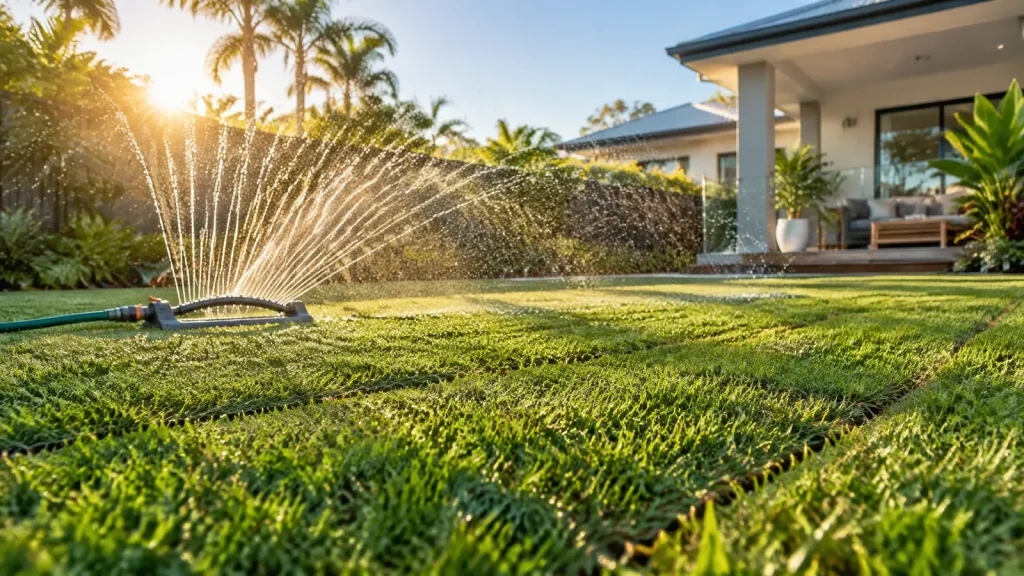
When watering new turf, soak it after laying until the soil is wet 100 mm down. Give light top-ups two to three times a day in week 1, water daily in week 2 and every second day in week 3, and soak deeply two or three times in week 4. Water more in Brisbane summers, about half as much in winter.
| Week | SEQ summer (Oct–Mar) | SEQ winter (May–Aug) | Water each time | What you’re aiming for |
|---|---|---|---|---|
| Day 1 | One long soak straight after laying | One long soak straight after laying | About 25 mm | Soil wet 100 mm below the turf |
| Week 1 | Light top-ups 2–3 times a day | Once a day, or twice on windy days | About 2–5 mm | Turf and the soil surface never dry out |
| Week 2 | Once a day | Every second day | About 5–8 mm | Moist, not soggy; roots starting to grip |
| Week 3 | Every second day | Every 2–3 days | About 10 mm | Soil drying slightly on top between waterings |
| Week 4 | 2–3 deeper soaks a week | 1–2 deeper soaks a week | About 12–15 mm (25–30 mm a week in summer) | Water reaching down past the roots |
| After week 4 | A deep soak when the footprint test says it’s thirsty | Only when the footprint test says so; a dormant lawn may need a soak every 1–2 weeks in a dry spell | About 20–25 mm | Deep roots, infrequent watering |
We’ve grown turf at Woodford since 1994 and supply new lawns across Brisbane and the Sunshine Coast, and this schedule follows our first 6 weeks of new lawn care plan. Treat it as a starting point: wind, heat, shade, soil and rain all change how fast new turf dries, and the tug and footprint tests below tell you when to adjust. Rain counts towards every amount in the table.
The first watering matters most. Freshly cut turf has only a thin layer of soil and roots, so it relies on the water you give it. Water each section as soon as it’s down, not when the whole job is finished.
You want roughly 25 mm of water on day one: enough to soak the turf and wet the soil underneath about 100 mm down. To see how long that takes with your sprinkler:
Then lift the corner of a slab. The soil beneath should be wet, not just damp on top. If it’s dry, keep going. On heavy clay, if water starts running off, stop for half an hour and then finish the soak.
Bone-dry soil pulls moisture out of new turf from below. Lightly water the prepared underlay before delivery so it’s moist but not muddy. For getting the ground ready, see our site and soil preparation service, how much soil to put under turf and how to lay turf on Queensland clay.
Want it laid and watered in for you? Our team can prepare the ground, lay the turf and water it in on the day. See turf installation or ask for a free measure and quote. Building a new home? Our front and backyard turf packages cover the whole yard.
For the first 7 to 10 days, the turf and soil surface should never dry out, or sit soggy. In warm weather that usually means two or three light top-ups a day of a few millimetres each: early morning, around midday and early afternoon. Give the joins, edges and any slabs next to paths, driveways or brick walls extra attention, as these dry out first. In cool, still winter weather, one watering a day is often enough. Laying in winter? See the best time to lay turf in Queensland.
By the end of the first week the slabs should lie flat and hold their colour, and the joins should be no wider than on laying day. A little yellowing on cut edges is normal. If gaps are opening, edges are curling or the leaf has turned a dull blue-grey, water more often. Don’t expect it to be rooted yet.
Cut back to one watering a day, but run it a little longer so the water gets below the turf into the soil. This is when new roots start to grow into the soil. In winter, every second day is usually plenty.
Water every second day and give more each time. Letting the top of the soil dry slightly between waterings makes roots grow down after the moisture below. In warm weather, most new lawns are firmly rooted by around weeks 2 to 3.
Move to two or three soaks a week. In summer, aim for about 25–30 mm a week in total, including rain: for example, two soaks of 12–15 mm. In winter, one or two soaks a week is usually enough. Watering less often but more deeply is what builds a drought-hardy lawn with a deep root system.
Once the turf is rooted and you’ve mowed it a couple of times, water only when the lawn tells you it’s thirsty (see the footprint test below), then give it a deep soak. Rain counts, so check a rain gauge before you turn on the tap. For the rest of the year, follow our seasonal turf care guide.
Haven’t ordered yet? Work out how much turf you need, with delivery, in the turf calculator.
How long to water new turf depends on your sprinkler, not the clock: output varies several times over between sprinkler types. Once the catch-cup test shows how much yours puts out in 15 minutes, use this table:
| Water in cups after 15 min | Week 1 top-up (2–5 mm) | Week 2 (5–8 mm) | Week 3 (10 mm) | Week 4 soak (12–15 mm) | Day 1 (25 mm) |
|---|---|---|---|---|---|
| 2.5 mm | 12–30 min | 30–50 min | 60 min | 75–90 min | 2.5 hours |
| 5 mm | 6–15 min | 15–25 min | 30 min | 35–45 min | 75 min |
| 10 mm | 3–8 min | 8–12 min | 15 min | 18–23 min | about 38 min |
Is 20 minutes enough? It depends on the sprinkler. If yours puts about 5 mm in the cups in 15 minutes, 20 minutes gives you roughly 7 mm. That suits a week-2 watering and is more than a week-1 top-up needs, but it falls well short of the day-1 soak and a little short of a week-4 soak. Always check by lifting a corner of a slab and looking at the soil.
Choose one that wets the whole area evenly without you walking on the turf to move it. An oscillating sprinkler suits square and rectangular yards and gives a gentle spray. An impact (ticking) sprinkler throws further, so it suits large or odd-shaped areas, but check the cups near and far from the head. A hand-held hose is handy for dry edges and joins but can’t give an even soak. Pop-up systems often miss corners, so run the catch-cup test on those too.
Hot sun and afternoon winds can dry new turf in hours, so stay at the top of the schedule; the week-1 midday top-up matters most on hot days. If a storm soaks the lawn, skip the next watering, but a quick sprinkle doesn’t count.
SEQ winters are dry but cool, so warm-season grasses root more slowly and need much less water. Start at about half the summer schedule. Soggy, cold soil slows rooting, so overwatering is the bigger risk.
Heavy clay and builder’s fill, common in Brisbane estates, soak up water slowly and hold it longer. If water runs off or pools, split each watering in two with a half-hour break, and water a little less often. Sandy Sunshine Coast soils drain and dry fast, so they usually need more frequent light waterings in weeks 1 and 2.
Still deciding which grass to lay? Compare all three in our turf varieties guide.
The tug test: from the end of week 2, gently lift the corner of a slab. If it comes up easily with no roots holding it, it hasn’t rooted yet; keep going with the schedule. If it resists and you can see white roots going into the soil, it’s rooting and you can move to the next week’s schedule.
The footprint test: walk across the lawn and look back. If your footprints stay flat for more than a few minutes, the grass is short of water.
| What you see | Likely cause | What to do |
|---|---|---|
| Gaps opening between slabs, edges curling | Too dry | Water more often, especially joins and edges |
| Blue-grey colour, leaves folding or curling | Too dry | Water today and check the soil under a slab |
| Straw-coloured patches along paths and walls | Heat from hard surfaces drying the edges | Give edges an extra hand-watering |
| Squelchy underfoot, water pooling | Too wet or poor drainage | Skip waterings until the surface firms up |
| Yellowing, mushrooms or a sour smell | Too wet for too long | Water less often and water in the morning only |
| Still not rooted after 4 weeks in warm weather | Often overwatering (shallow roots) or poor soil contact | Cut back to deeper, less frequent soaks and check the soil under the slabs |
If yellowing or patches don’t improve once the watering is right, it may be a disease or pest problem. See our guide to grubs, diseases and weeds.
Patchy new lawn? If parts of the lawn still aren’t coming good, our lawn care services in Brisbane can take a look.
Early morning is best: it’s cool and calm, so less water is lost, and the leaves dry off during the day. Avoid regular evening watering, as leaves left wet overnight in humid SEQ weather are prone to fungal disease. The exception is week 1, when midday and early-afternoon top-ups stop new turf drying out.
Print this or screenshot it and stick it near the back tap. Tick a box each time you water.
| Week | Mon | Tue | Wed | Thu | Fri | Sat | Sun |
|---|---|---|---|---|---|---|---|
| 1 (2–3 top-ups a day) | ☐ ☐ ☐ | ☐ ☐ ☐ | ☐ ☐ ☐ | ☐ ☐ ☐ | ☐ ☐ ☐ | ☐ ☐ ☐ | ☐ ☐ ☐ |
| 2 (once a day) | ☐ | ☐ | ☐ | ☐ | ☐ | ☐ | ☐ |
| 3 (every 2nd day) | ☐ | – | ☐ | – | ☐ | – | ☐ |
| 4 (2–3 deeper soaks) | ☐ | – | – | ☐ | – | ☐ | – |
In winter, tick one box a day in week 1 and about half the boxes after that.
Two to three light top-ups a day for the first 7 to 10 days in warm weather, then once a day in week 2. In a cool SEQ winter, once a day in week 1 is often enough.
Long enough to apply about 2–5 mm per top-up in week 1, 5–8 mm in week 2, 10 mm in week 3 and 12–15 mm per soak in week 4. A catch-cup test tells you how many minutes that takes with your sprinkler.
It depends on your sprinkler. Twenty minutes is often plenty for a week-1 or week-2 watering, but usually too short for the day-1 soak. Lift a slab corner to check the soil underneath is wet.
New Sir Walter buffalo follows the same schedule as other turf: light top-ups two to three times a day in week 1, daily in week 2, every second day in week 3, then two or three deeper soaks in week 4. Water shaded areas less, as they dry out more slowly.
Yes. Constantly soggy soil keeps roots shallow, slows rooting and invites fungal problems, especially in winter and on clay. If it squelches underfoot or water pools, skip waterings until the surface firms up.
Yes. Watering in the sun won’t burn the grass, and in week 1 a midday top-up on a hot day is what stops new turf drying out.
Only if the rain wasn’t enough. A heavy soaking storm can replace a watering, but a light shower won’t. Lift a slab corner: if the soil underneath is wet, skip that watering.
Keep it to a minimum in the first two weeks. Position sprinklers so you can move them from the edges, and step on a board if you have to cross the lawn.
Use the tug test: gently lift a slab corner. If it resists and white roots are growing into the soil, it has rooted. In warm weather that’s usually around weeks 2 to 3; in winter it takes longer.
Flat, green and with tight joins. It won’t be rooted yet. Opening gaps or a blue-grey tinge are signs it’s drying out.
It’s optional. Seasol is a seaweed tonic, not a fertiliser, and it doesn’t replace watering. Hold off on fertiliser until around weeks 4 to 6.
Early morning. The exception is week 1, when hot days also call for midday and early-afternoon top-ups.
Turf watered well for its first four weeks roots quickly and needs far less water afterwards. Still planning? The turf calculator shows how much you need, or our team can lay and water it in for you. For fertilising and mowing, follow our starter care and maintenance plan, and check our turf FAQs or more new lawn care guides.
Ready to order turf?
Fresh-cut turf from our Woodford farm, delivered across Brisbane and the Sunshine Coast. Work out your area and price in the turf calculator.
More in New Lawn Care

Copyright ©2026 Hancey's Turf - Designed by Smart Local