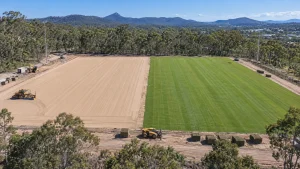
When sand slit drainage, laser levelling and returfing will fix a waterlogged oval, when a full rebuild pays off, and real QLD field projects.

Sand slit drainage, laser levelling and returfing will fix most waterlogged ovals, as long as the field’s shape and subgrade are basically sound. Renovate when the problem is surface water, compaction or uneven levels. Rebuild when the subgrade has failed, the field needs major reshaping, or you want a new layout. A levels survey and soil tests tell you which.
| Renovation (drainage retrofit) | Full rebuild | |
|---|---|---|
| What it fixes | Waterlogging, compaction, weeds and uneven levels | A failed or badly shaped subgrade, a new layout, or a field that must play soon after heavy rain |
| Scope | Weed kill, ripping, laser levelling, laterals, sand slits (now or later), returf | Strip and reshape, full subsurface drainage, new irrigation, often a sand rootzone, returf |
| Depth of work | Mostly the top 300 mm plus drain trenches; the existing soil stays | The whole profile, often with cut and fill and a 100 mm sand rootzone on top |
| Programme on our jobs | Colleges Rugby Union: 3 weeks (laterals only; slits staged later) | Sheldon College 4 weeks and Clive Berghofer 5 weeks of works, each followed by a 10-week grow-in |
| Time out of play | A close-season window; sand slitting on its own causes little disruption | About 14–15 weeks to play on those two rebuilds; Football Queensland warns a complete reconstruction could close a ground for at least 12 months |
Every SEQ oval goes soft after a big storm. A drainage problem is when it stays unplayable long after. Look for:
At Colleges Rugby Union the cause was a shallow layer of compacted topsoil over impermeable clay, common on older SEQ ovals.
Sand slit drainage is a system of narrow trenches cut across a field’s pipe drains and backfilled with sand, or with gravel capped by sand. The slits carry surface water straight through compacted topsoil and clay to the gravel and pipes below, instead of letting it sit on the surface.
A well-drained field relies on three things working together.
The surface is shaped so water runs off before it soaks in. Football Queensland’s Natural Turf Football Pitches Construction and Management Guideline recommends no more than 1 in 200 along the line of play and 1 in 100 across it, with 1% as the preferred maximum grade. It accepts up to 1 in 50 on community pitches. On our jobs, finished falls have ranged from 1% (Clive Berghofer, Sheldon College) to 1.2% (North Pine) and 1.4% on a crowned rugby field (Colleges).
Perforated pipes in gravel-filled trenches run across the field into a collector or ring main, then to an outlet. On our projects, lateral spacing has ranged from 8.5 m (North Pine) to 10 m (Clive Berghofer, Bob Brock soccer field) and 14 m (Colleges Rugby Union).
The Football Queensland guideline describes retrofitted slits about 75–100 mm wide and 250 mm deep, spaced as close as 1 m apart. At Sheldon College we installed 50 mm wide gravel bands at 500 mm centres and 200 mm deep, with a machine that cuts, backfills and compacts three slits per pass.
That’s why laterals alone often disappoint: on clay, water can’t move sideways to a pipe 10 or 14 m away. At Colleges the budget covered laterals first, mainly to outlet a close-spaced slit system added later.
Many SEQ ovals are thin topsoil over heavy clay, and summer storms drop a lot of rain fast. Slits need regular sandy topdressing so they don’t cap over. We install sand slit drainage systems and pipe laterals on school, club and council fields across Brisbane, the Sunshine Coast and South East Queensland.
A renovation keeps the existing subgrade and fixes the top of the profile. Our usual order of work is:
It’s the same principle as topdressing and levelling a bumpy lawn, at field scale.
The Football Queensland guideline says that where site shape and soil are poor, the ideal is a complete reconstruction. Where the shape is OK and the soil is reasonable, a network of subsurface drains through the surface may be enough. It also notes a tipping point where retrofitting costs approach a proper rebuild. A rebuild is usually the better spend when:
For the full construction process, from survey to handover, see our sports field construction guide for Queensland.
We ripped, laser graded to a 1.4% crown, installed laterals at 14 m centres to take a future slit system, and returfed 7,700 m² of Wintergreen couch. The work was finished in three weeks. Read the Colleges Rugby Union case study.
A 25-year-old field that became unplayable after moderate rain. We decompacted the red clay site soil, added drainage at 10 m centres and laser graded to a 1% fall to swale drains: five weeks of works plus a 10-week grow-in. See the Clive Berghofer field rebuild.
A 25,000 m² reshape moving more than 7,000 m³ of soil, with new irrigation, drainage and Wintergreen couch, delivered within the eight-week summer school holidays. See the Genesis College total rebuild.
A new oval designed around the site’s Q100 flood level, with every grade and drain falling to the irrigation dam so runoff is recycled. It has laterals at 8.5 m centres and a 100 mm amended USGA sand rootzone at a 1.2% fall. See the North Pine Christian College project.
More school, club and council fields are in our recent projects.
Couch establishes fastest in warm soil, so in SEQ the main window is roughly September to January, after winter codes finish. On many school and council ovals that clashes with summer cricket, so the programme has to be agreed with the cricket users. Genesis College, which includes a cricket field, was rebuilt in the summer school holidays.
We only work the ground when it’s dry, so allow for storm delays, and book the assessment in autumn or winter.
The main cost drivers are:
As a rebuild benchmark, the Queensland Government’s 2018 sport and recreation facility costs fact sheet put a natural grass soccer field (8,214 m²) at $434,000 and a rugby league or union field (10,400 m²) at $550,000. Those are indicative June 2018 figures for earthworks, drainage, irrigation and grass on a clean, flat SEQ site, so allow for cost increases since, and for sloping sites or poor soils. A renovation or slit drainage retrofit avoids most of the earthworks, although an extensive retrofit can approach rebuild cost. Either way, get a site-specific quote before you apply for grants.
Most SEQ fields we build or renovate get Wintergreen couch from our Woodford farm: hard wearing and quick to recover. For sand profiles we supply turf grown on sand-based paddocks, as at Sheldon College. Clive Berghofer in cooler Toowoomba was turfed with kikuyu. Wintergreen is listed at $7.00/m², and field-scale supply and installation is quoted per project.
Many online answers about field drainage are really about synthetic pitches, which drain through a stone base under the carpet. Natural turf relies on falls, slits, pipes and an open rootzone. If you’re weighing up a switch, price a natural turf renovation alongside any synthetic quote.
Close together: Football Queensland describes spacing as close as 1 m, and we used 500 mm at Sheldon College. The more slits installed, the more of the surface is treated, but every extra slit adds machine time and backfill sand, so spacing is a budget decision.
Deeper than the slits. At Sheldon College the 100 mm laterals sat in trenches 300 mm below the finished subgrade, and at Colleges Rugby Union the collector mains ran 650–850 mm deep. Slits are around 200–250 mm and must reach the gravel over the pipes.
Yes, provided the surface is smooth and reasonably shaped. Levels are corrected first, then laterals go in to an outlet and slits are cut across them. The work can be split into stages so each fits a funding round.
It comes down to whether the subgrade stays. A renovation works with the soil you have. A reconstruction removes or reshapes it and builds a new profile, so it costs more and takes the ground out of use for longer.
The works themselves can be quick: three weeks at Colleges Rugby Union. Plan for the grow-in too. New turf needs to knit and be mown several times before it takes studs, and our rebuild grow-ins have run 8–10 weeks.
The main variables are field area, slit spacing, whether laterals already exist and how much sand is needed. If suitable laterals are already in, you are paying for the slits and sand only. We quote after a site assessment.
Usually, yes. Football Queensland describes sand slitting as a way to improve drainage without major expense or disruption, and the surface is normally playable again within a short period. We confirm the exact closure at assessment.
Spring to early summer, while couch is growing strongly. Book the assessment a season ahead so the design and any grant application are ready before the winter codes finish.
Not sure if your oval needs sand slits, a renovation or a rebuild? We grow the turf at Woodford and build the fields, so one team handles assessment, sand slit drainage, levelling and turf for sports fields across Brisbane and the Sunshine Coast. See our commercial and sports turf construction service, or request a quote and we’ll arrange a look at your field.
More in Sports & Commercial Turf

Copyright ©2026 Hancey's Turf - Designed by Smart Local