How a natural-turf sports field is built in Queensland, from earthworks and drainage to grow-in, with cost drivers, government benchmarks and timelines from our own field projects.
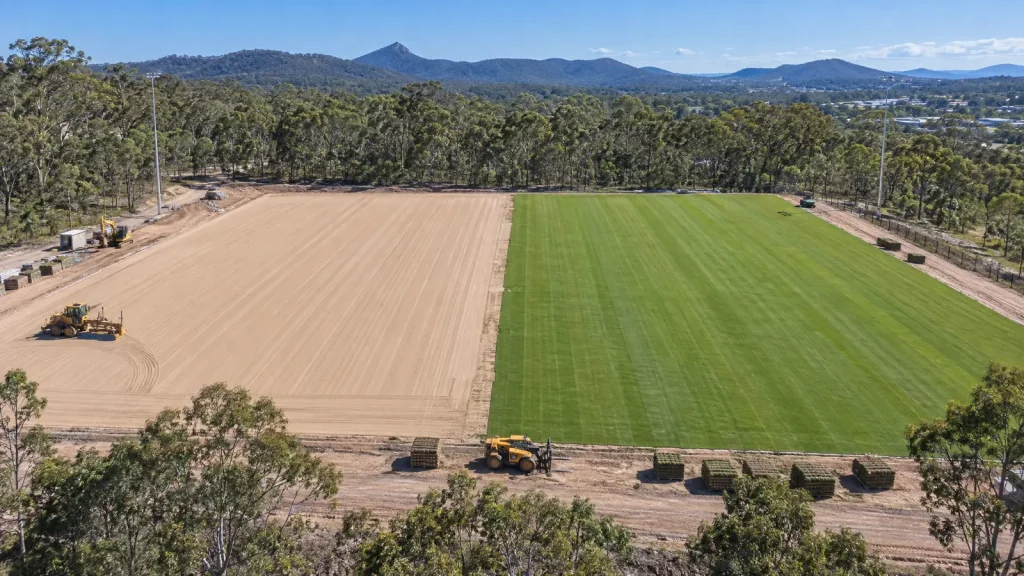
Sports field construction in Queensland follows eight stages: site investigation, design, earthworks, drainage, irrigation, rootzone, turfing and grow-in. On our projects, building has taken four to eight weeks, plus six to 13 weeks of grow-in. The QLD Government’s 2018 benchmark was $434,000 for a natural-grass soccer field, excluding GST. Earthworks, drainage and the rootzone drive the cost.
| Question | Short answer |
|---|---|
| Main stages | Investigate, design, earthworks, drainage, irrigation, rootzone, turf, grow-in |
| Build window (our projects) | 4 to 8 weeks on site, depending on scope and weather |
| Grow-in before play | 6 to 13 weeks of mowing, feeding, top-dressing and pest control |
| Typical surface falls | About 1% on a drained field; 1.4% where there is no subsurface drainage |
| Grading tolerance | ±10 mm on the subgrade; ±5 mm on a high-spec rootzone |
| Drain spacing | 5 to 10 m centres, sometimes with sand or gravel slit bands between |
| Usual SEQ turf | Couch (we grow Wintergreen); kikuyu suits cooler sites such as Toowoomba |
| Biggest cost swings | Earthworks volume, drainage design, imported sand depth, washed vs unwashed turf |
| Best time to turf in SEQ | Spring to early autumn, when couch is actively growing |
“Sports field construction” can mean three quite different jobs, and the price and timeline follow from which one you need:
This guide covers natural turf; we compare it with synthetic further down.
This is the sequence we follow on our sports turf construction projects. The numbers come from our own completed jobs.
| Stage | What happens | Get it right |
|---|---|---|
| 1. Site investigation | Level survey, soil tests, service location, existing outlets and irrigation | Reactive or sodic clay changes the design |
| 2. Design | Layout, falls, drainage, irrigation and rootzone spec | About 1% falls on a drained field |
| 3. Earthworks | Strip, decompact, shape with GPS or laser control, add gypsum | Trim the subgrade to ±10 mm |
| 4. Drainage | 100 mm ag pipe in gravel trenches at 5 to 10 m centres to a lawful outlet | Trench only in dry conditions |
| 5. Irrigation | Pop-up sprinklers, pump and controller; heads capped and GPS-plotted | Protect pipework under the rootzone |
| 6. Rootzone | Imported sand (100 to 250 mm) or amended native soil | Push out from the edge; test compaction and infiltration |
| 7. Turf | Inspected paddock, slabs or big rolls, washed if specified, laid and rolled | Harvest to laid within 18 to 24 hours |
| 8. Grow-in | Mowing, feeding, top-dressing, rolling, weed and pest control | Agree acceptance criteria up front |
Mistakes in the subgrade show up for years. At Genesis College in Bray Park, more than 7,000 m³ of soil was moved with machine-controlled dozers, then finished with a laser box blade. At the Les Hughes rugby league fields, also in Bray Park, a machine-control GPS dozer shaped the fields to design. At Samford a laser bucket took the subgrade to ±10 mm at a 1.4% fall, and gypsum was ripped into the clay. More on the soil side on our site and soil preparation page.
Drainage keeps a field playable after an SEQ summer storm. The Metricon Stadium training field on the Gold Coast was designed for rainfall of up to 100 mm an hour, with laterals at 5 m centres feeding a ring main. At Bob Brock in Dakabin, pipe at 10 m centres was enough. At Sheldon College, gravel slit bands 500 mm apart connect the surface to the pipes.
High-spec fields sit on sand: 250 mm with a little peat at Samford and Narangba, 200 mm of amended local sand at Mackay. Sand drains fast and resists compaction but needs more water and fertiliser. At Clive Berghofer Stadium in Toowoomba, the client reused the red clay site soil, decompacted, amended and drained, as a deliberate cost saving.
For a large job we set aside a paddock early and grow it for the end use. Council specs may require inspection for purity, weeds, density, pests and disease. Slabs harvest thinner than big rolls, which helps rooting, and can be laid at up to 10,000 m² a day against about 4,000 m² for rolls. Washed big rolls suit specs that allow no soil on the sand. Most of our fields use Wintergreen couch grown at Woodford; from a sand-based paddock it can match the profile without washing.
Plan for two windows, not one: the build window (machines on site) and the grow-in window (turf establishing before play).
If grow-in time is the problem, turf can be pre-grown. For the 2018 Commonwealth Games, in partnership with HG Turf, we grew 25,000 m² of Wintergreen couch in HG’s hybrid turf system at Woodford over a 12-month grow-in, for the opening and closing ceremonies and Metricon Stadium’s main field.
The Queensland Government publishes indicative facility costs for grant applicants. Its current Sport Facilities Costs sheet (prices at May 2026) no longer lists natural-grass football fields. The 2018 facility costs fact sheet did, at June 2018 prices:
| Field (2018 fact sheet) | Area | Natural grass | Synthetic grass |
|---|---|---|---|
| Soccer, 111 × 74 m incl. run-off | 8,214 m² | $434,000 | $1,555,000 |
| Rugby league or union, 130 × 80 m | 10,400 m² | $550,000 | $1,968,000 |
| AFL or cricket oval, 175 × 155 m | 27,125 m² | $1,431,000 | $5,130,000 |
Use them as a sense check, not a quote:
Reuse good site soil where tests support it, keep irrigation that still works, source rootzone sand locally (as at Mackay, which also makes matching top-dressing easy), specify unwashed slabs from a sand-based paddock where the profile allows, and book the turf paddock early.
Planning a field build or rebuild? Book a site assessment and we’ll walk the field, check the soil and drainage, and give you a realistic scope before you commit to a budget.
On capital cost, natural turf is well ahead: in the 2018 figures above, synthetic soccer cost about 3.6 times as much. Over 20 years the gap narrows, because the costs fall differently:
The answer depends on weekly hours of use, so compare whole-of-life costs on the same basis.
The first season decides how the field plays for years. Our grow-in programs have included mowing couch at about 30 mm, rolling, 10 mm sand top-dressings, keeping soil pH around 6 to 7, and core tests for root depth (Samford’s acceptance criterion was 200 mm). Top-dress with the same sand as the rootzone to avoid layering, rotate high-wear areas, and ask for a maintenance manual at handover.
| Project | Location | Area | Scope | Build window | Grow-in |
|---|---|---|---|---|---|
| Genesis College | Bray Park | 25,000 m² | Total rebuild; turfed in 4 days | 8-week holiday window, incl. grow-in | 6 weeks |
| Les Hughes rugby league fields | Bray Park | 15,000 m² | GPS shaping, soil amendment, Wintergreen | n/a | 13 weeks |
| Bob Brock soccer field | Dakabin | 7,000 m² | Council rebuild, 10 m drains, sand layer | n/a | 8 weeks |
| Samford sports precinct | Samford | 50,000 m² complex | 250 mm sand, 5 m drains, washed rolls | n/a | 12 weeks |
| Narangba sports complex | Narangba | 30,000 m² | Two soccer fields, 250 mm sand | About 2 months | n/a |
| Sheldon College | Sheldon | 9,000 m² | Infield, drains and slit bands | 4 weeks | 10 weeks |
| Clive Berghofer Stadium | Toowoomba | 9,000 m² | Reused clay, 10 m drains, kikuyu | 5 weeks | 10 weeks |
| Harmony sports fields | Palmview | 49,000 m² of turf | Soil prep, grading, turf supply | 10 weeks (turfing) | n/a |
| Metricon Stadium training field | Carrara | 20,000 m² | Drainage retrofit | 4 weeks | n/a |
| Mackay sports precinct (2018) | Mackay | 7,000 m² | Athletics infield, 5 m drains | n/a | n/a |
| Commonwealth Games turf (with HG Turf) | Woodford | 25,000 m² | Pre-grown hybrid turf | n/a | 12 months (pre-grown) |
n/a means the project page doesn’t record that figure. See more on our recent projects page.
A clear brief gets comparable quotes. Include:
The Queensland Government’s 2018 fact sheet put a natural-grass soccer field at $434,000 and a rugby field at $550,000, excluding GST, lighting, goals and fencing. Costs have risen since, and earthworks, drainage and the rootzone decide the real figure.
On our projects, site works have taken four to eight weeks, then six to 13 weeks of grow-in before play. Wet weather and winter turfing both add time.
Stripping the old surface, decompacting the subgrade, shaping it to the design falls with GPS or laser control and trimming to about ±10 mm, often with gypsum worked into clay.
Couch in South East Queensland, because it wears well, recovers quickly and handles heat. Kikuyu suits cooler inland sites such as Toowoomba.
In South East Queensland, most football, rugby and cricket fields are couch. Cooler inland sites often use kikuyu, and some stadiums use hybrid turf. In cooler southern states, ryegrass, or couch oversown with ryegrass, is common on AFL grounds.
Not always. High-use fields often sit on 100 to 250 mm of sand for drainage and wear. Good native soil can be decompacted, amended and drained instead, at lower cost.
On our projects, laterals have run at 5 to 10 m centres depending on falls, soil and rainfall, sometimes with sand or gravel slit bands between them.
Yes, with planning. Genesis College’s 25,000 m² field was rebuilt, turfed in four days and ready for play within an eight-week summer holiday window.
Natural turf is far cheaper to build; the 2018 government figures put synthetic at about 3.6 times the cost. Over 20 years synthetic adds carpet replacement and infill, and natural adds mowing, water and renovation, so compare whole-of-life costs.
We have grown turf at Woodford since 1994 and supply sports fields and commercial sites across Brisbane, the Sunshine Coast and beyond. If you’re scoping a field build, rebuild or renovation, read about our sports field construction service or book a site assessment to get a realistic scope, budget range and timeline. Prefer to talk it through? Call 1800 761 334 or use our contact page.
More in Sports & Commercial Turf

Copyright ©2026 Hancey's Turf - Designed by Smart Local